London house prices haven't crashed. On paper they're up. That's why so few people have noticed what has actually happened to them over the last ten years.
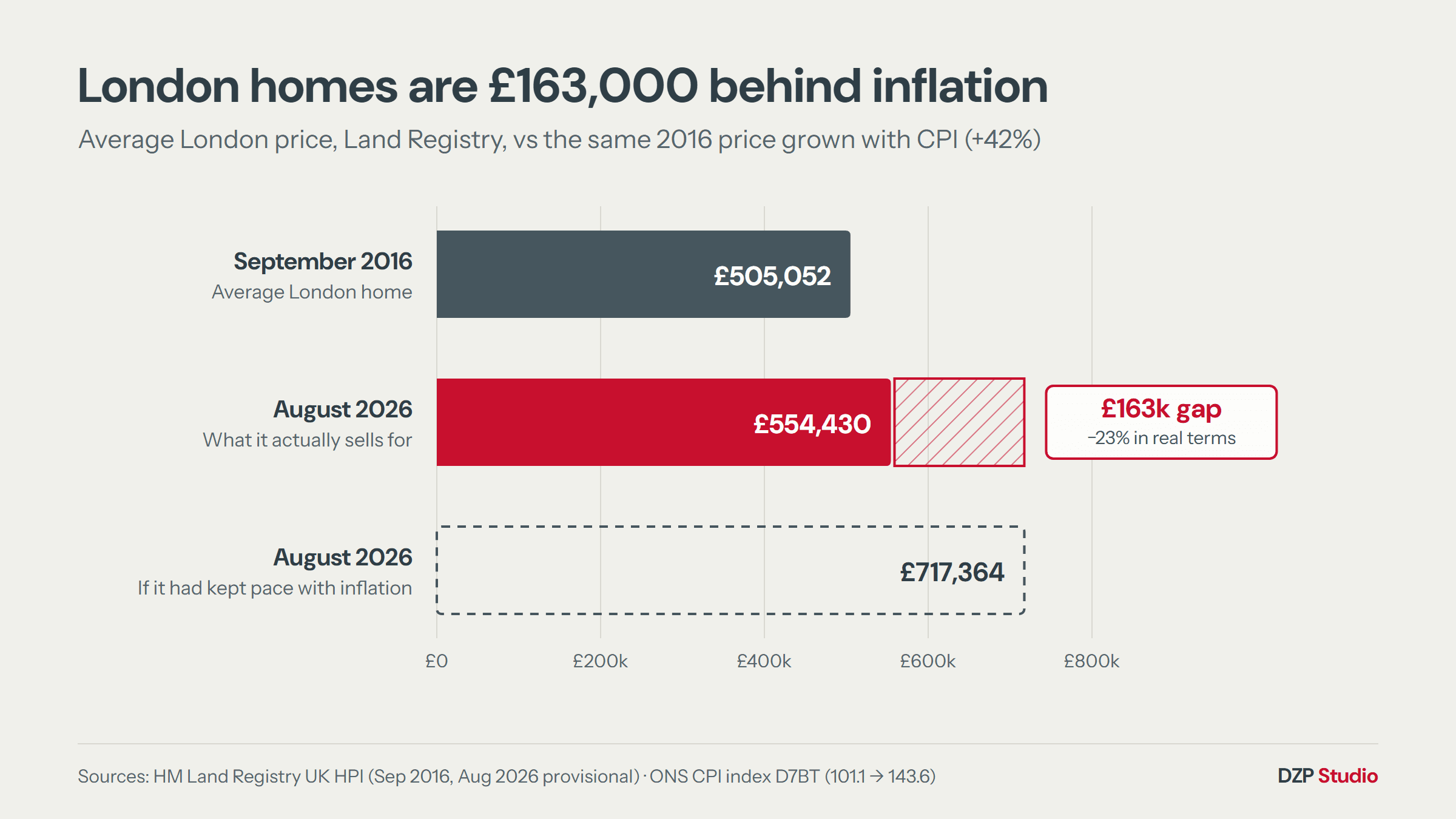
In September 2016 the average London home sold for £505,052. By August 2026 it was £554,430, according to HM Land Registry's UK House Price Index. That's a 10% rise in a decade, roughly 1% a year.
Over the same ten years, consumer prices rose 42% (ONS CPI). If the average London home had just kept pace with inflation it would be worth about £717,000 today. It's £163,000 short. Adjusted for inflation, the average London home has lost 23% of its value since 2016.
The rest of the country did much better. The UK average rose 38% over the same period, which left it only about 3% behind inflation. London went from the market everyone wanted to be in to the worst performer in the country.
Flats took the hardest hit
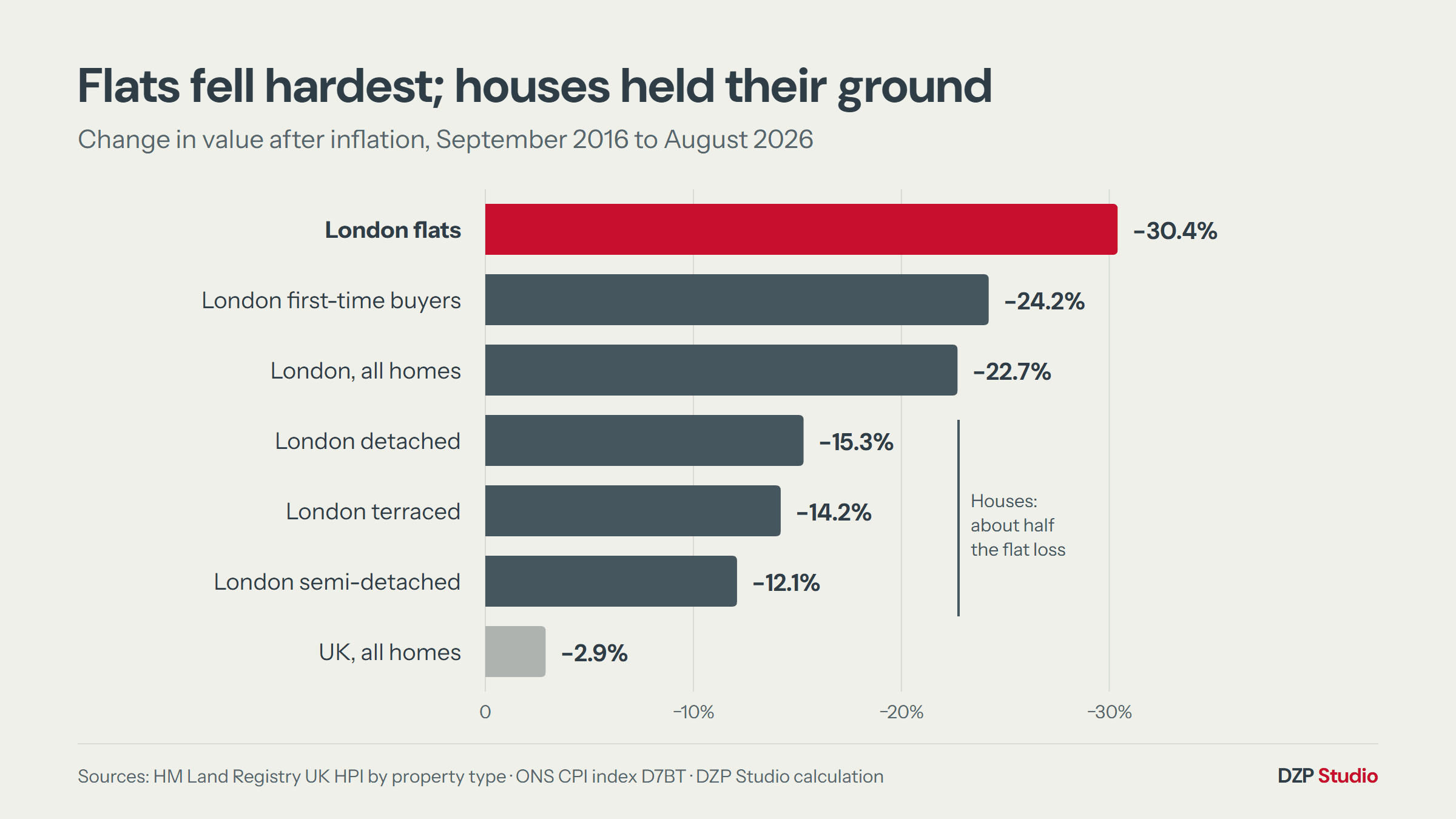
The fall wasn't even across the market. London flats are now cheaper in cash terms than they were ten years ago: £432,378 in September 2016 against £427,310 in August 2026. Adjusted for inflation that's a 30% fall.
Houses held up much better. Terraced, semi-detached and detached houses in London lost between 12% and 15% in real terms. That's still a real loss, but it's about half the hit flats took.
There's no single cause. Mortgage rates went up sharply after 2022. London buyers pay the most stamp duty because London prices are the highest. Tax and regulation changes pushed many small landlords out of the flat market. Working from home changed what people want from a home. The decline is still going: London prices are down 2.2% on a year ago, and prime central boroughs have dropped further. Westminster is down 14.3% and Kensington and Chelsea 13.8% year on year.
Ten years of falling real prices tells you one thing. London is now cheaper, relative to everything else, than at any point in the past decade.
Meanwhile, the stock market is betting on AI
While London property drifted, global stock markets did the opposite, led by a small group of US technology companies.
The "Magnificent Seven" (Apple, Microsoft, Nvidia, Alphabet, Amazon, Meta and Tesla) now make up roughly 35% of the S&P 500, up from about 12% a decade ago. That figure comes from the IMF's October 2026 Global Financial Stability Report, which lists a sharp correction in AI-linked shares as one of the three biggest near-term risks to the global financial system.
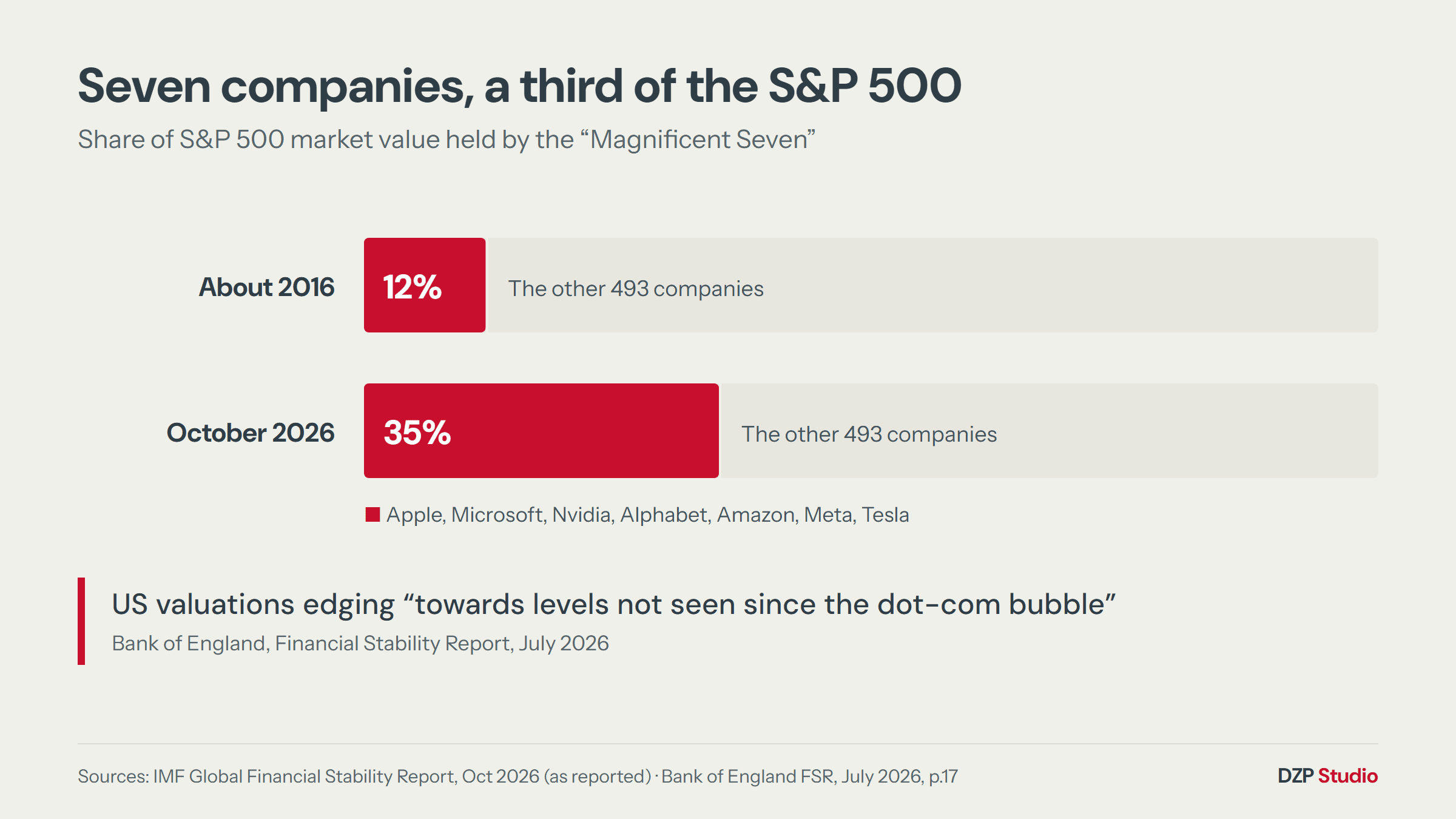
The Bank of England is saying the same thing. In its July 2026 Financial Stability Report the Bank said the excess CAPE yield on the S&P 500, a long-run valuation measure, has been "edging downwards towards levels not seen since the dot-com bubble". It also warned that a reassessment of AI companies' prospects "could trigger a fall in equity prices that might be amplified by high concentration". AI and semiconductor stocks fell sharply that same month, and some leveraged investors were forced to sell out of their positions. After its September meeting, the Bank's Financial Policy Committee was blunt: "The risk of a sharper correction persists."
None of this means a crash is coming. Nobody can time that, and these companies are profitable in a way that dot-com firms weren't. But it does mean that anyone holding an S&P 500 or global index fund (which includes most workplace pensions) has a third of their US exposure riding on seven companies and one theme. That's not what most people think of as diversified.
Why bricks look different right now
The main stock indices are priced for strong growth. London property has spent ten years falling behind inflation. Those are very different starting points.
- The price has already reset. You aren't buying at a peak. You're buying after a 23% real-terms fall, and more than that for flats and prime central London.
- The demand hasn't gone away. The London Plan aims for around 52,000 new homes a year, but London has built far fewer than that year after year. CBRE estimates the capital is more than 50,000 homes short of its 2021 targets, and all but four boroughs have missed their London Plan targets.
- Property is driven by different things. House prices depend on local supply, incomes and mortgage rates, not on how the market values AI chips.
- Houses beat flats. London houses lost about half as much value as flats did. Over the last decade, buyers have paid more for space and land than for location alone.
Property comes with risks of its own. Prices can fall further, borrowing is still more expensive than it was before 2022, and buying and selling costs a lot. But for anyone thinking long-term, it's worth knowing that London prices are lower in real terms than at any point in the last ten years.
The part you control: adding value to the house
Most of a property's value is set by the market. But part of it is set by what you do to the property, and that's the part you can control.
Developers use the term GDV (gross development value) for what a property is worth once the works are finished. The same idea works for a single family house. You buy at today's price, add space, and the extra value is equity you've created that the market didn't give you.
Nationwide's October 2025 research puts numbers on it:
- Adding a double bedroom and a bathroom to a typical three-bed, one-bath house through an extension or loft conversion can add up to 24% to its value.
- Adding a fourth bedroom to a three-bed home adds 10–13%.
- Adding 10% more floor area adds up to 5%.
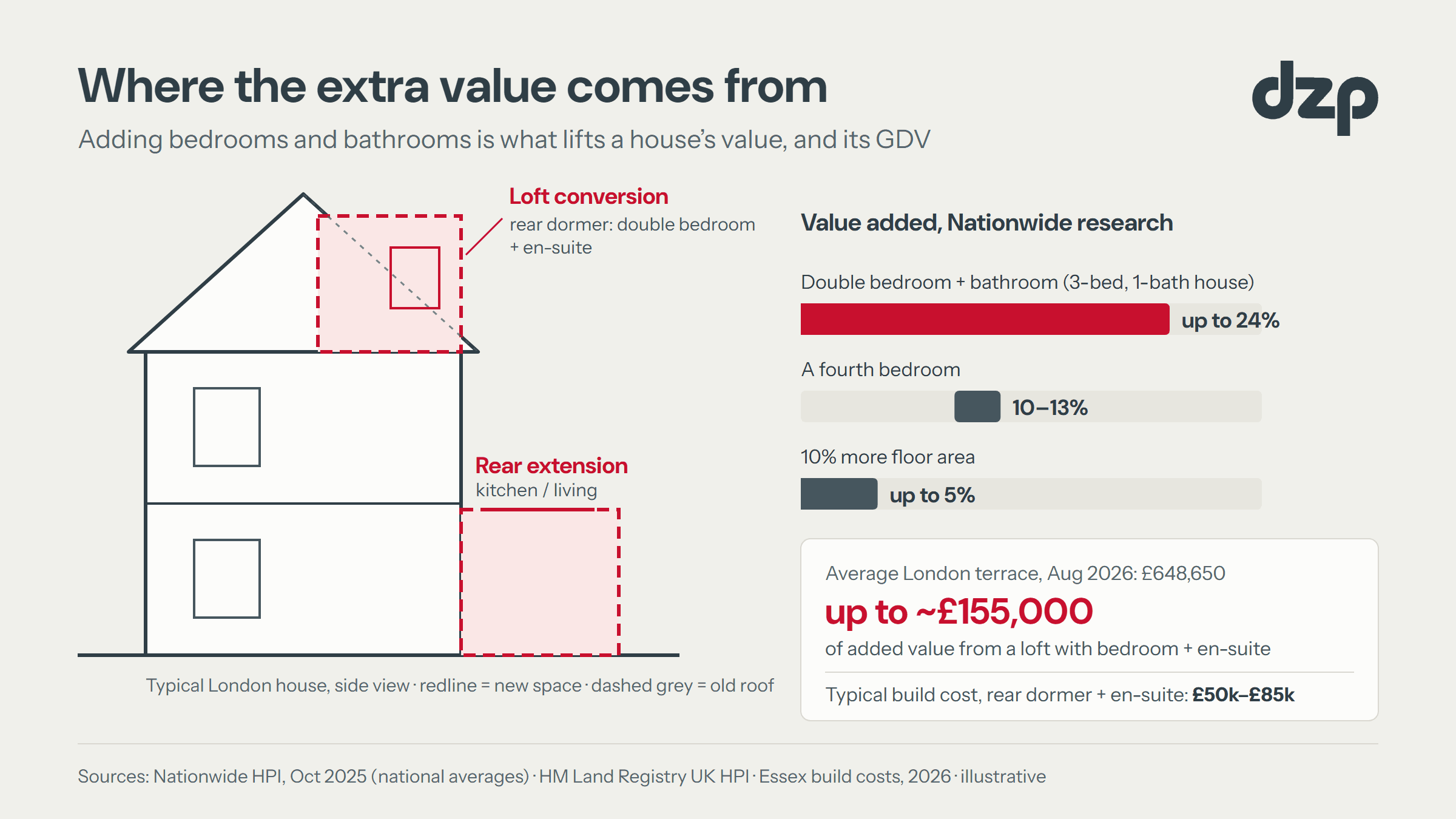
Here's what that looks like in London. The average terraced house sold for £648,650 in August 2026. On Nationwide's figures, a loft conversion adding a double bedroom and en-suite could add up to around £155,000 of value.
The cost is far lower. Based on published 2026 building costs in Essex, where we do much of our work, typical loft conversions cost:
| Type of loft conversion | Typical cost (Essex, 2026) |
|---|---|
| Basic, with roof windows (Velux) | £25,000–£42,000 |
| Rear dormer | £50,000–£75,000 |
| Hip-to-gable | £55,000–£82,000 |
| Mansard | £62,000–£105,000 |
| With an en-suite bathroom | often £50,000–£85,000+ |
Estimates vary with the property and the specification.
A rear dormer with an en-suite (the kind of loft Nationwide's figure describes) comes in at around £50,000–£85,000. Even at the top of that range, the potential uplift is nearly double the build cost. Building in inner London usually costs more, and professional fees, VAT and finance all come off the margin. But the gap between what you spend and the value you add is the value you create.
Many London houses can be extended without full planning permission, under permitted development. That covers a single-storey rear extension of 3 m (or 4 m on a detached house), or up to 6 m and 8 m through the prior approval process, and a loft dormer of up to 40 m³ on a terrace or 50 m³ on a semi or detached house. A hip-to-gable loft on a semi is often possible under these rights; a mansard almost always needs full planning permission. But those rights don't apply in conservation areas, many London streets have Article 4 directions that remove them, and flats don't have them at all. Whether a particular house has room to extend, and how much, depends on what's already on the planning record. That's where a good architect saves you the most money.
How DZP Studio helps
We're a RIBA chartered practice working across London and Essex, and we start every project with two questions: what can you build, and is it worth building?
- Before you buy: our plotwise by DZP report (£149) sets out the planning constraints, permitted development potential, nearby applications and sold-price comparables for any address in England. You'll know whether a house can be extended before you make an offer.
- Design for value: we design extensions and loft conversions around what adds value in your street. That might be a fourth bedroom, a second bathroom or a kitchen that opens onto the garden, rather than floor area for its own sake.
- Getting consent: we handle planning applications, lawful development certificates, prior approvals, appeals and building regulations drawings, so you can start building as soon as the design is agreed.
A good buying strategy in London right now is to look past the finished, fully extended house. Look instead for the one with an unconverted loft, a side return or a deep garden, check what the planning rules allow, and add the space yourself.
Get the plotwise report for your address, or send us an enquiry about your project.
This article is general commentary, not financial or investment advice. Property values can fall as well as rise. Past performance is not a guide to future returns. Speak to a regulated financial adviser before making investment decisions. Value-uplift figures are national averages from Nationwide research and will vary by property and location.
Sources
House prices
- HM Land Registry, UK House Price Index: London and UK averages by property type, September 2016 and August 2026. https://landregistry.data.gov.uk/app/ukhpi/
- ONS, Private rent and house prices, UK: August 2026. https://www.ons.gov.uk/economy/inflationandpriceindices/bulletins/privaterentandhousepricesuk/august2026
- ONS, Housing prices in Kensington and Chelsea (local profile, includes the London average). https://www.ons.gov.uk/visualisations/housingpriceslocal/E09000020/
- MoneyWeek, London house prices: Is the capital's property boom over? https://moneyweek.com/investments/property/london-house-prices
Inflation
- ONS, CPI index 00: All items, 2015=100 (series D7BT): 101.1 in September 2016, 143.6 in August 2026. https://www.ons.gov.uk/economy/inflationandpriceindices/timeseries/d7bt/mm23
Equity markets and AI
- Bank of England, Financial Stability Report, July 2026 (pp. 17, 23). https://www.bankofengland.co.uk/-/media/boe/files/financial-stability-report/2026/financial-stability-report-july-2026.pdf
- Bank of England, Financial Policy Committee Record, September 2026. https://www.bankofengland.co.uk/financial-policy-committee-record/2026/september-2026
- IMF, Global Financial Stability Report, October 2026. https://www.imf.org/en/Publications/GFSR
- Quartz, IMF warns AI stock crash could threaten global financial stability. https://qz.com/imf-ai-stock-crash-global-financial-stability-101326
- Forbes, S&P 500's weight in Mag 7 stocks passes 30%. https://www.forbes.com/sites/investor-hub/article/sp-500-weight-mag-7-stocks-diversification-risk/
Housing supply
- CBRE, Borough-by-borough report highlights housing shortfall. https://www.cbre.co.uk/press-releases/cbres-borough-by-borough-report-highlights-housing-shortfall
Extensions and value
- Nationwide, House Price Index, October 2025 (special analysis on extensions and loft conversions). https://www.nationwide.co.uk/media/hpi/download/oct-2025
- Which?, Loft conversion is the key to boosting your property value, report reveals. https://www.which.co.uk/news/article/loft-conversion-is-the-key-to-boosting-your-property-value-report-reveals-aWK2K2K9ziMC
- MHCLG, Permitted development rights for householders: technical guidance. https://www.gov.uk/government/publications/permitted-development-rights-for-householders-technical-guidance
- Planning Portal, Extensions. https://www.planningportal.co.uk/permission/common-projects/extensions/